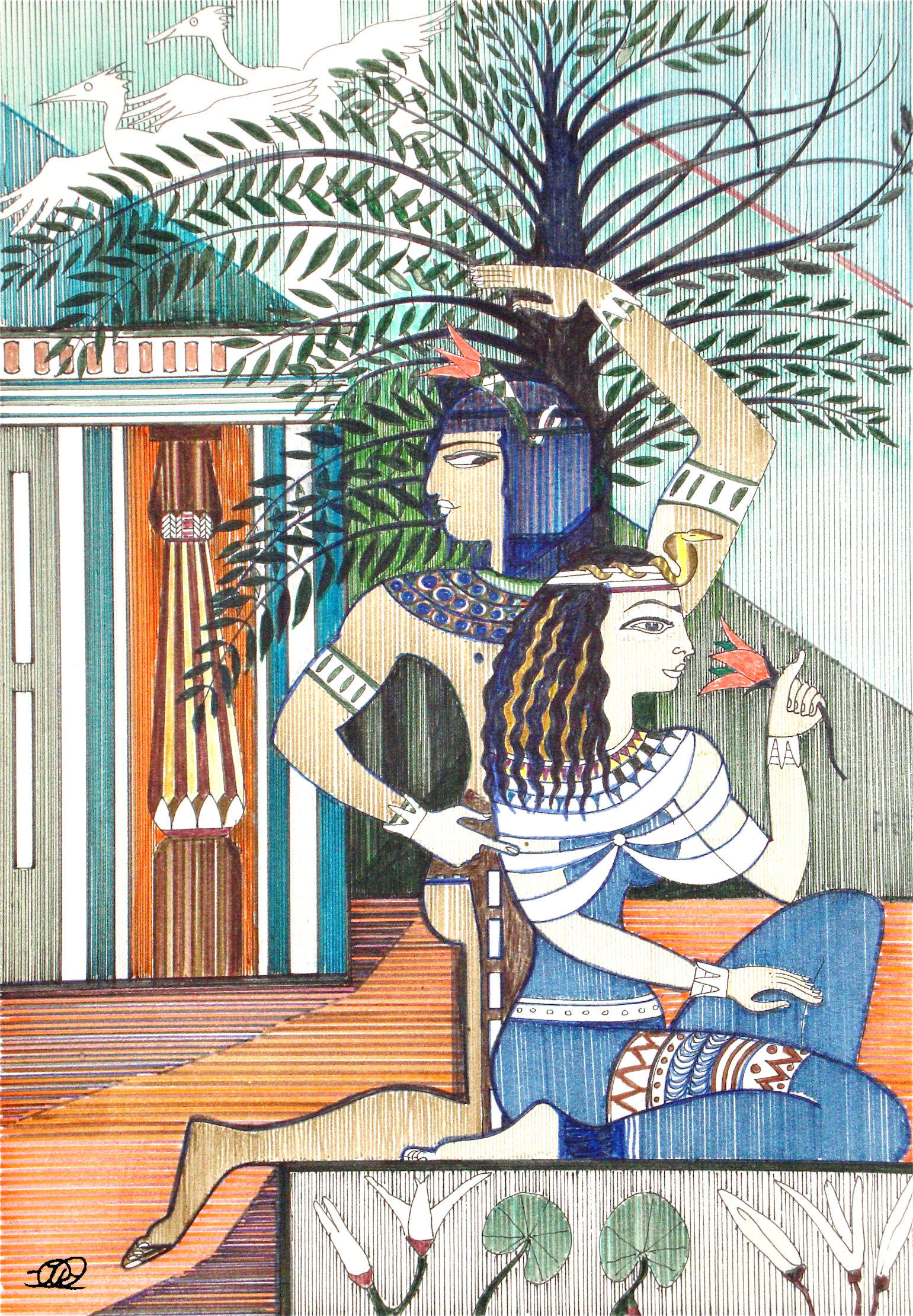
This stylized drawing, apparently inspired by ancient Egypt, features male and female characters, a pair of cranes nestled in a large “palm,” and a waterlily/lotus motif at the bottom. With strong use of blue, teal, green, and rusty oranges, it is among Floyd’s more colorful works.
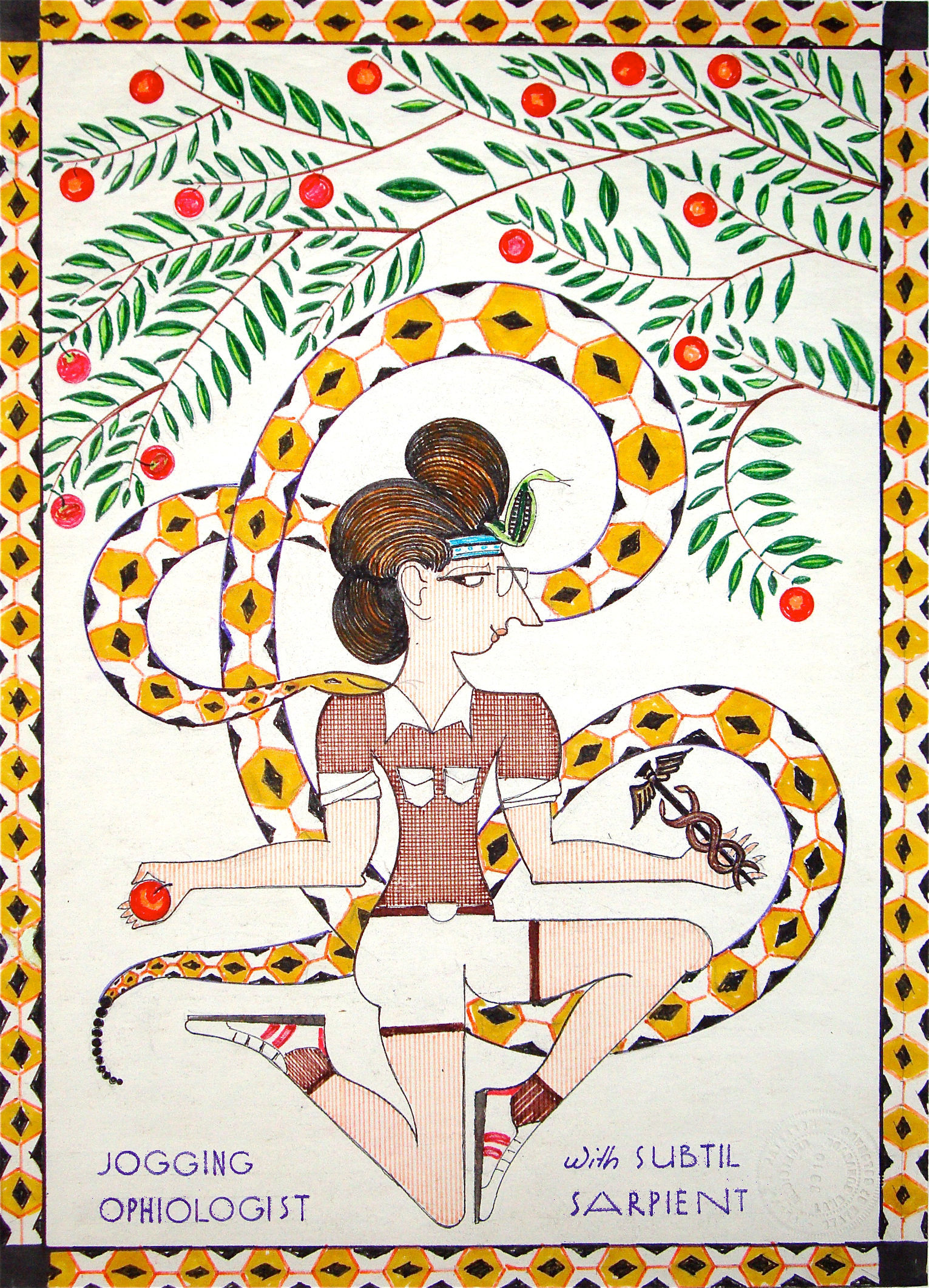
Floyd’s student of snakes seems to be courting danger here. Is she tempting fate?
Hand-lettered title: “Jogging Ophiologist with Subtil Sarpient”
This charming drawing seems a challenge to interpret, and I’m reluctant to attempt it, but here’s at least a description. This female ophiologist is clearly focused on academic pursuits, carrying a caduceus in her left hand and what appears to be an apple in her right. Glasses perched on her nose give her a studious air as she looks askance. A cobra(?) headband nestles in her brown hair, which is piled high on her head. The large snake coiled behind her rests its head on her shoulder as she jogs. Its size suggests a python, but it also has a hint of rattles on its tail. Its yellow and black diamond pattern is echoed in the border of the drawing. Green branches above their heads hold red fruits; out on a limb, I’d have to say they look more like poisonous yew than apples.
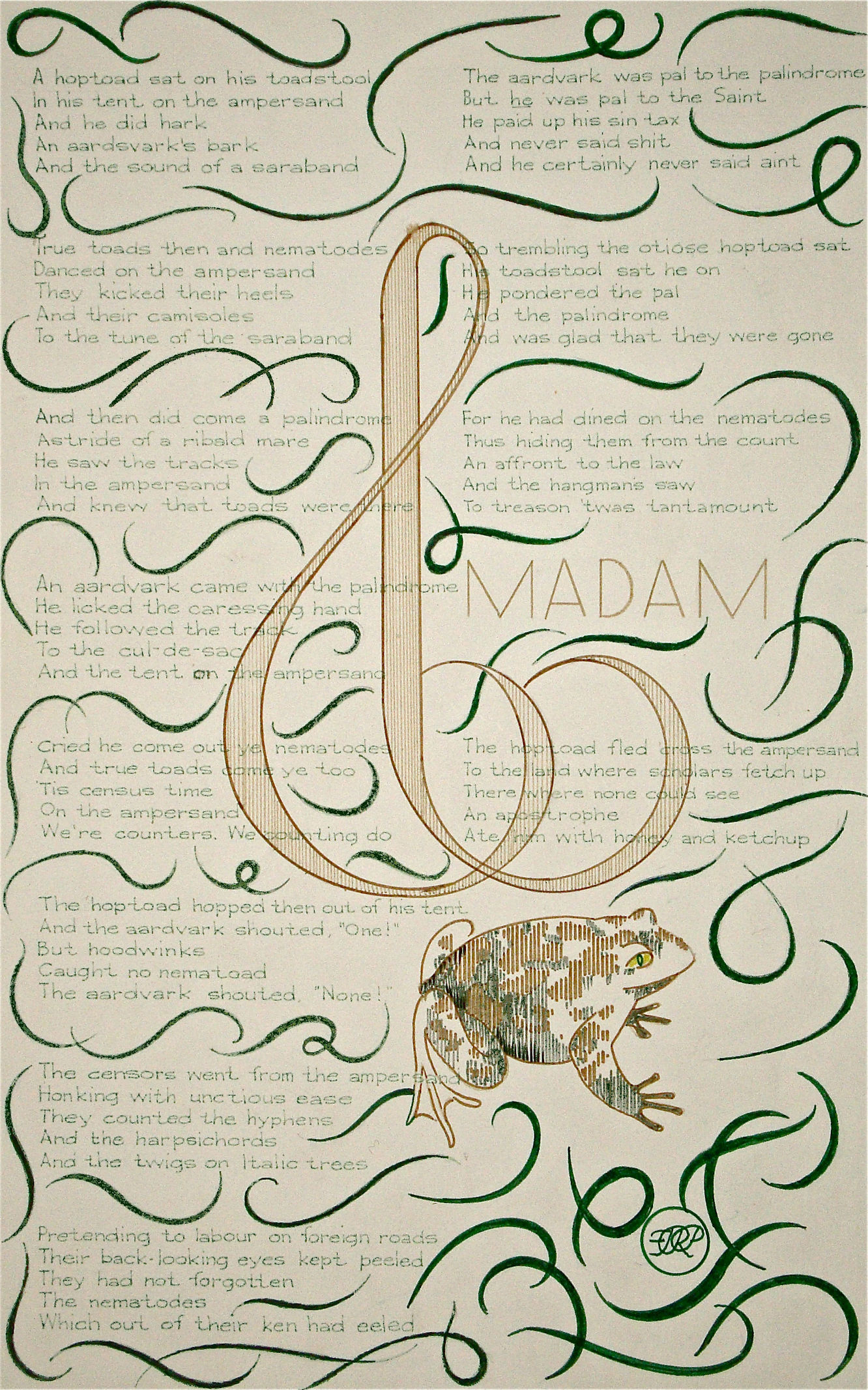
This hand-lettered, illustrated poem by Floyd Peterson offers twelve stanzas of delicious word-play, clearly best when read aloud.
A hoptoad sat on his toadstool In his tent on the ampersand And he did hark To an aardvark’s bark And the sound of a saraband (1)
True toads then and nematodes Danced on the ampersand… (2)
…
The aardvark was pal to the palindrome And he was pal to the Saint He paid up his sin tax And never said shit And he certainly never said ain’t (9)
As poetry, this piece is odd, perhaps unique. Its five-line stanzas have the rhythm of limericks, but an unusual scheme of consistently rhyming only the second and fifth lines. Except in stanzas 1, 4, 11, and 12, where the third and fourth lines also rhyme.
The illustration includes a giant ampersand (&) and the word “MADAM” (itself a palindrome) in brown, a drawing of a toad in green and brown, and decorative, presumably nematodean, green swirls.
Laced with imagery from punctuation, music, and zoology, this nonsense poem strikes the ear as akin to the poetry of Edward Lear or Lewis Carroll. Floyd sprinkled the stanzas with obscure words (unctious, otiose, eeled), juxtaposed “true toads” with “nematoads” at one point, and made a noun out of “hoodwink,” all for linguistic fun.
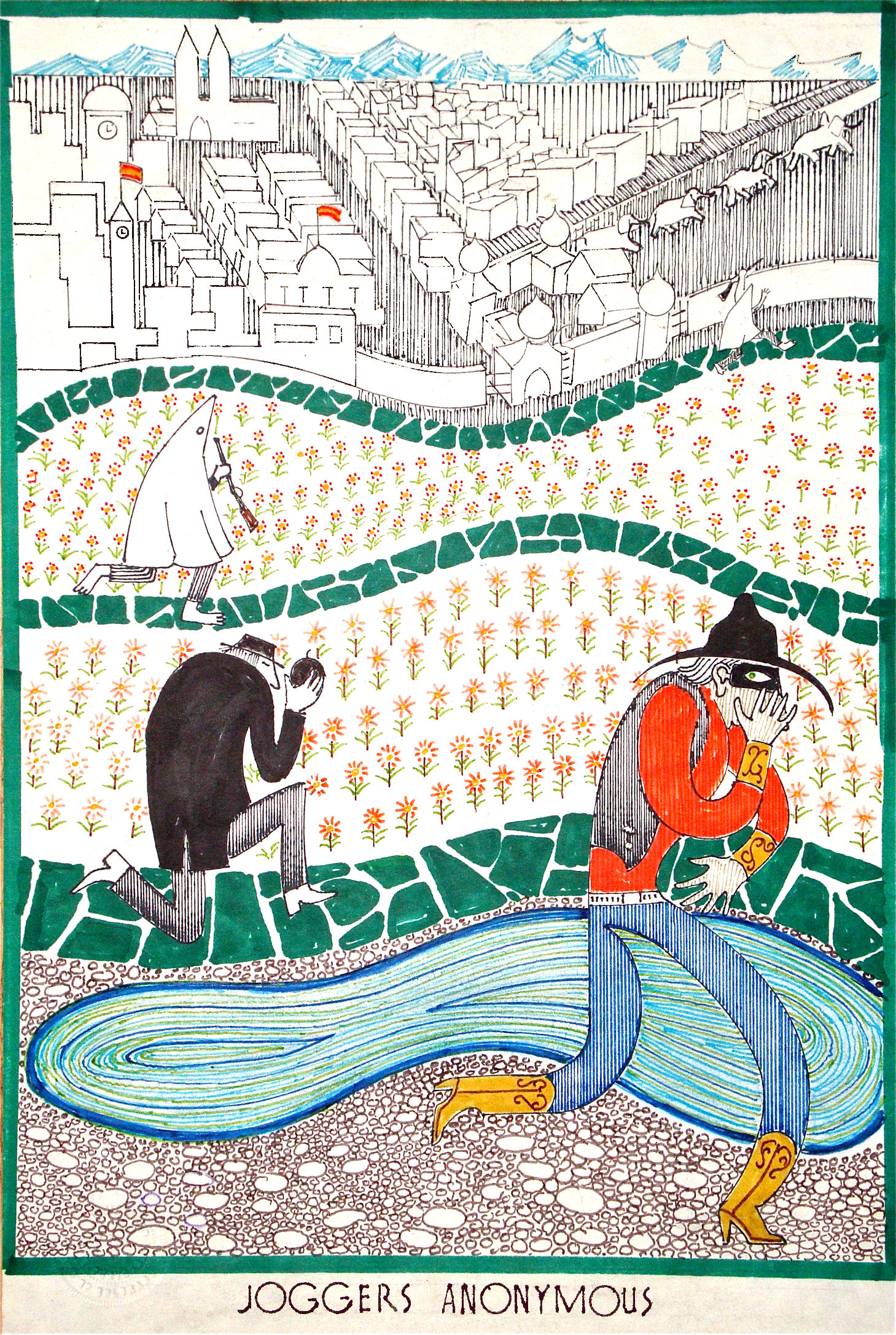
Joggers Anonymous: Four people jog along flagstone paths, with a city and mountain skyline as a backdrop.
In this colorful drawing, a diverse collection of joggers, none showing their face, runs along green flagstone paths between flowery fields. In front is a masked cowboy; the second is a suspicious figure carrying a bomb(?); and two resemble Klansmen with rifles. In the distance, four elephants parade through city streets, while turquoise mountains loom in the background.
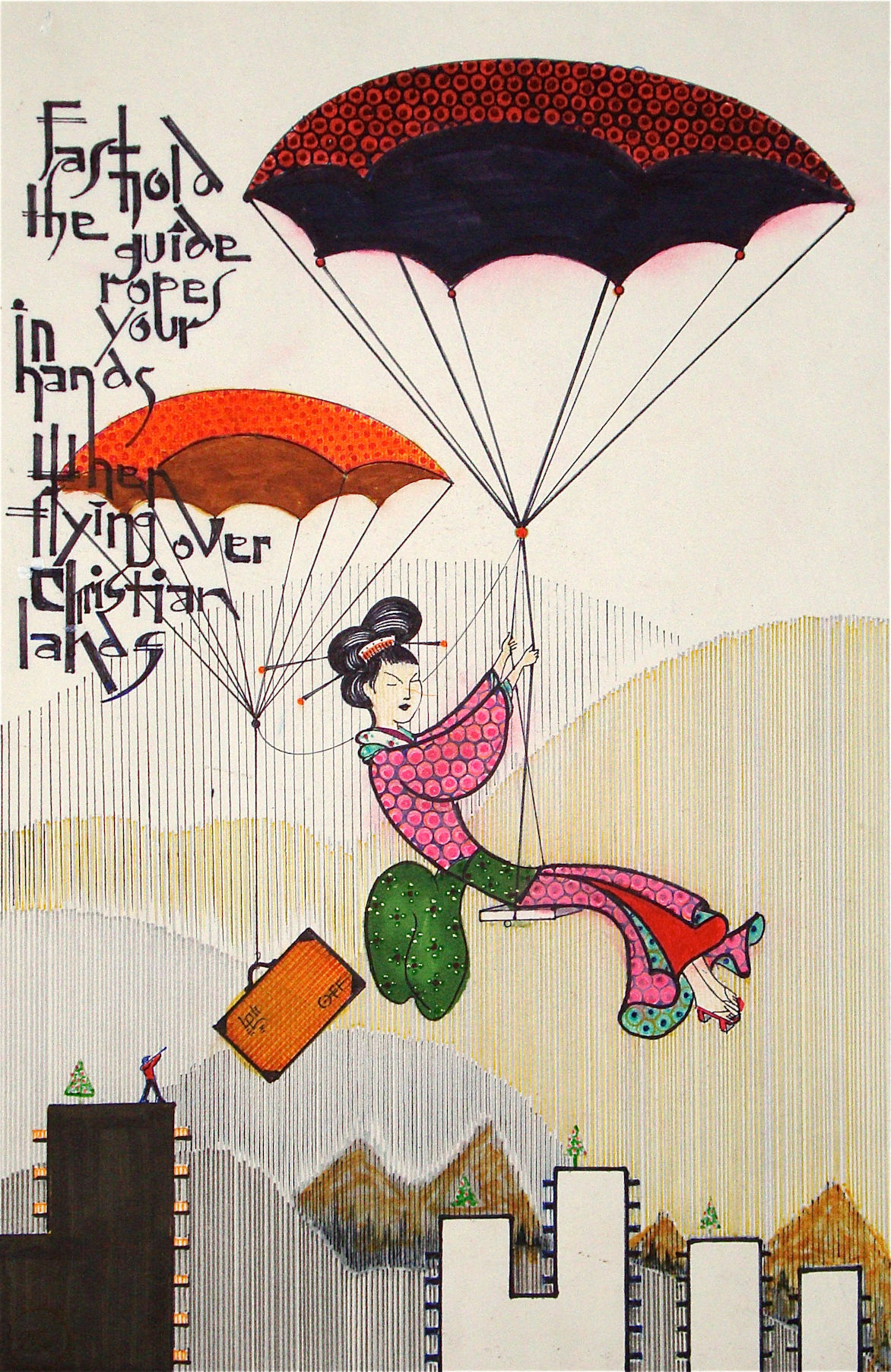
“Fast hold the guide ropes in your hands when flying over Christian lands.”
An adventurous cognoscente brings her suitcase along while parasailing over an urban, yet mountainous, region. Tall buildings in the foreground appear to be apartments with protruding balconies. Atop several buildings are shapes resembling Christmas trees, but also, on one rooftop, a figure apparently pointing a rifle at the flying object above. The rifle and the cautionary caption add an ominous note to what seems, at first glance, a serene scene.
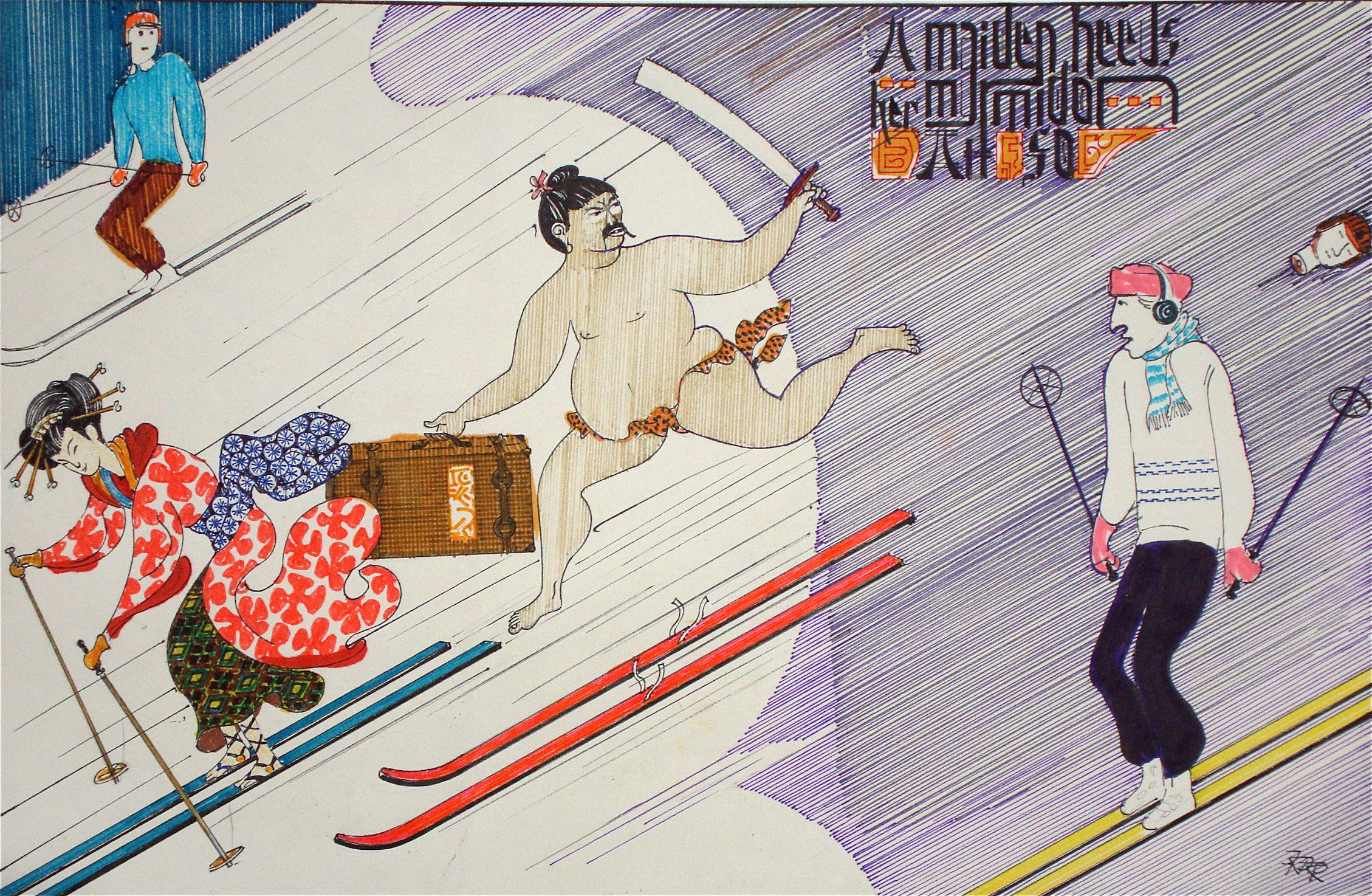
“A maiden heeds her myrmidon” is Floyd’s label for this drawing.
Floyd always has a way of expanding our (okay, my) vocabulary. His love of words applies especially to obscure and bizarre words with intriguing sounds. In this colorful image, a Sumo-styled myrmidon follows a cognoscente as she careens down a ski slope, carelessly dispatching with a sword those who get too near his charge.
In Greek mythology, the Myrmidons were a race of people created by Zeus from a nest of ants. They settled in Thessaly and were led by Achilles in the Trojan War. In a broader sense, the term refers to a follower or henchman. It can also describe someone who blindly obeys a powerful person or authority, even when doing bad things. In general, a myrmidon is a loyal follower who executes orders without protest or pity. (Apparently I failed to record the source of this paragraph. Sorry!)
In modern times (as recently as 2011), according to World Wide Words, it has been applied to “holders of public office who are carrying out unpopular policies,” however:
“It is less effective than it might be as a term of abuse because it requires the addressee to have at least a smattering of classical knowledge.”
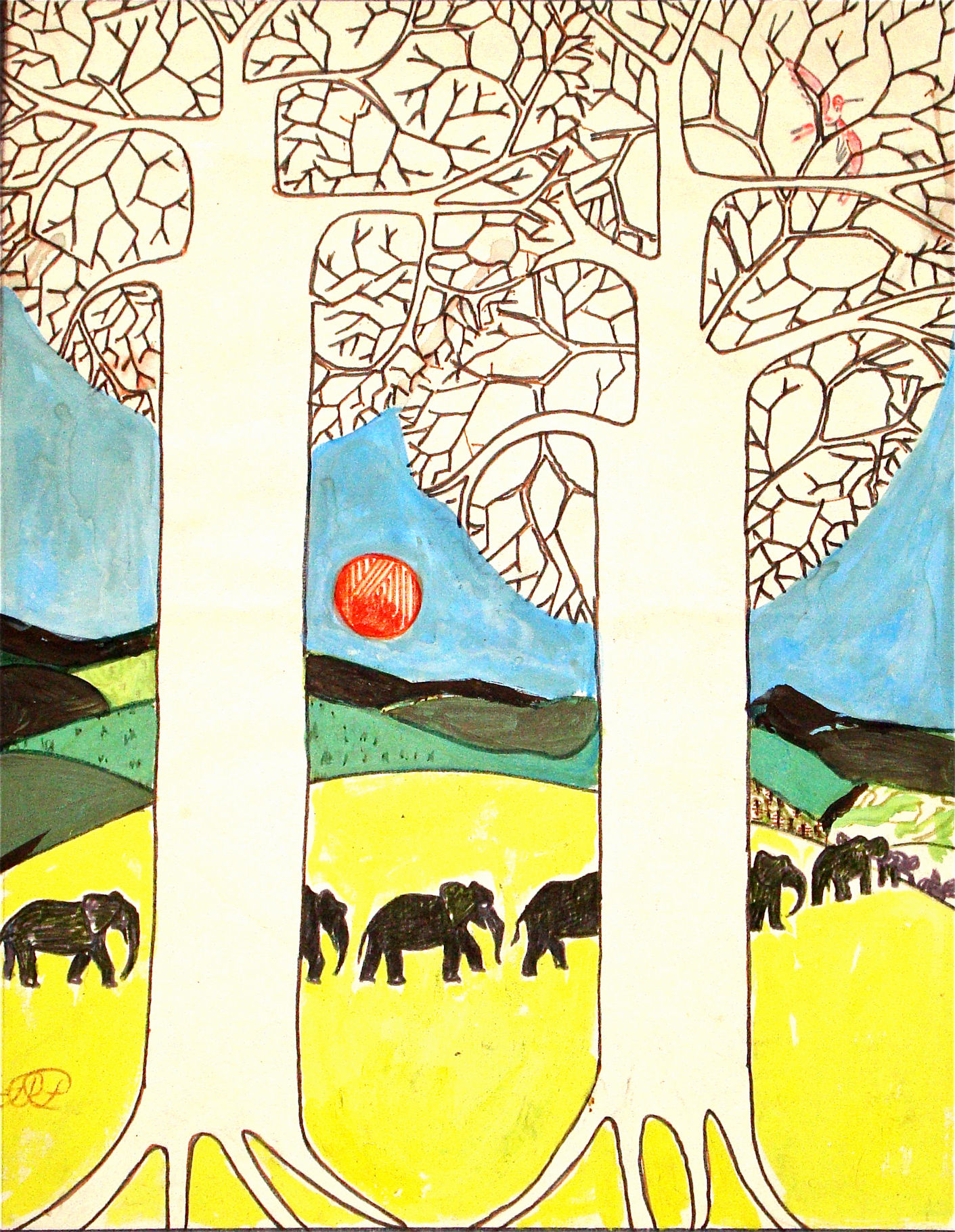
Untitled drawing by Floyd R. Peterson. Elephants parade across a bright yellow landscape, behind two large trees. Hills in the distance are shades of green and black, under a blue sky with a red sun.
Bright colors and stylized trees are unusual features in this drawing of a landscape. The elephants suggest a setting far from the American West Floyd usually features.
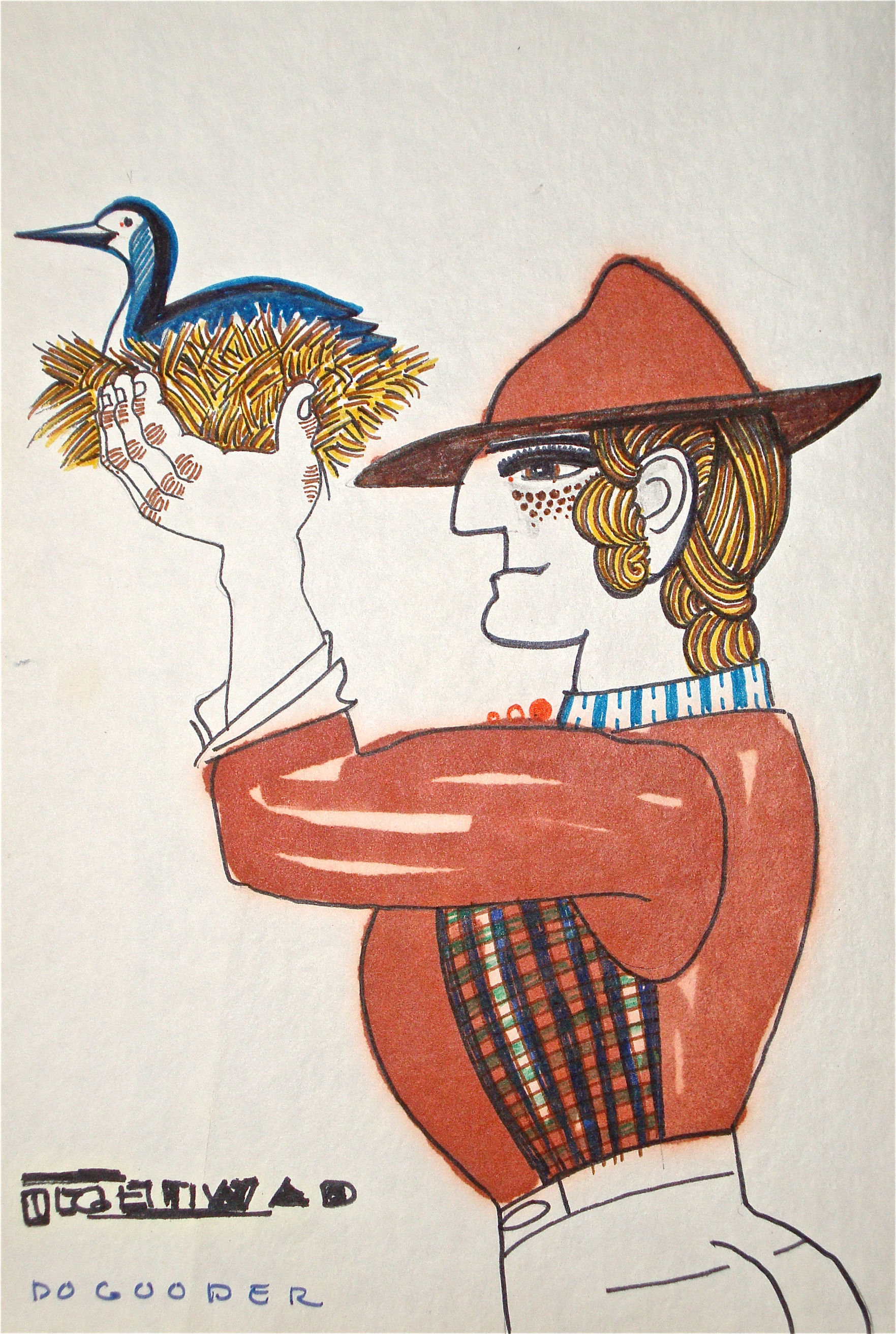
This image, labeled “Do Gooder” by Floyd, depicts a man in red shirt and hat lifting a bird in its nest, presumably to replace it in a tree.
Something about this drawing suggests a Royal Canadian mountie, or perhaps a Dudley Do-Right character, coming to the rescue of an unfortunate fallen bird. His muscular physique, steely gaze, and strong jawline speak of a hero for whom such tasks are routine.
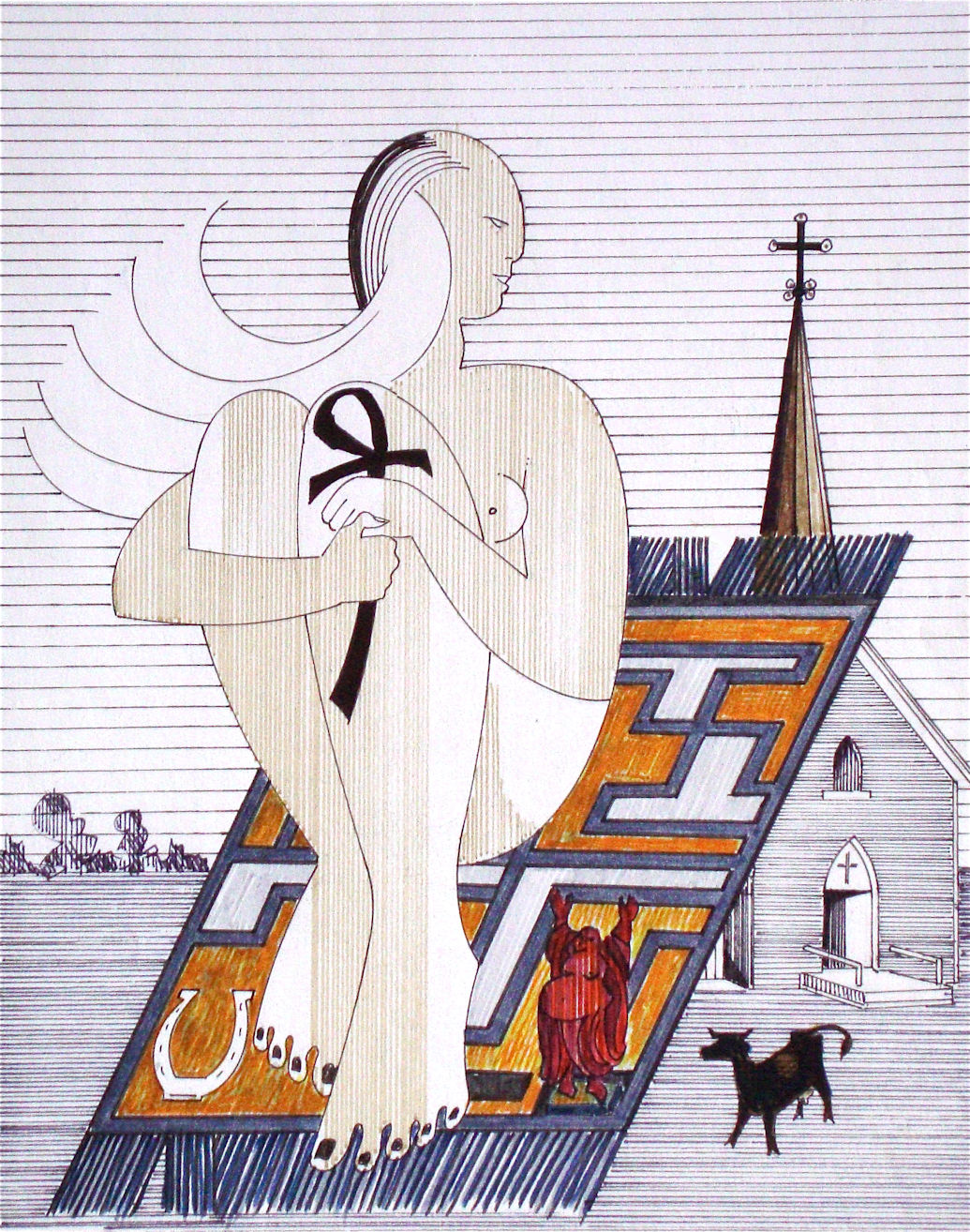
Untitled: A naked woman holding an ankh rides a flying carpet past a church.
In this image of a woman on a flying carpet, the background is largely black-and-white, while the carpet and woman in the foreground show strong use of color. A cow is standing in the churchyard; the carpet has a horseshoe and a Hotei figure, or laughing Buddha. The drawing juxtaposes the ankh, Egyptian symbol of eternal life, with the Christian crosses on the church steeple and door.

 Floyd R. Peterson